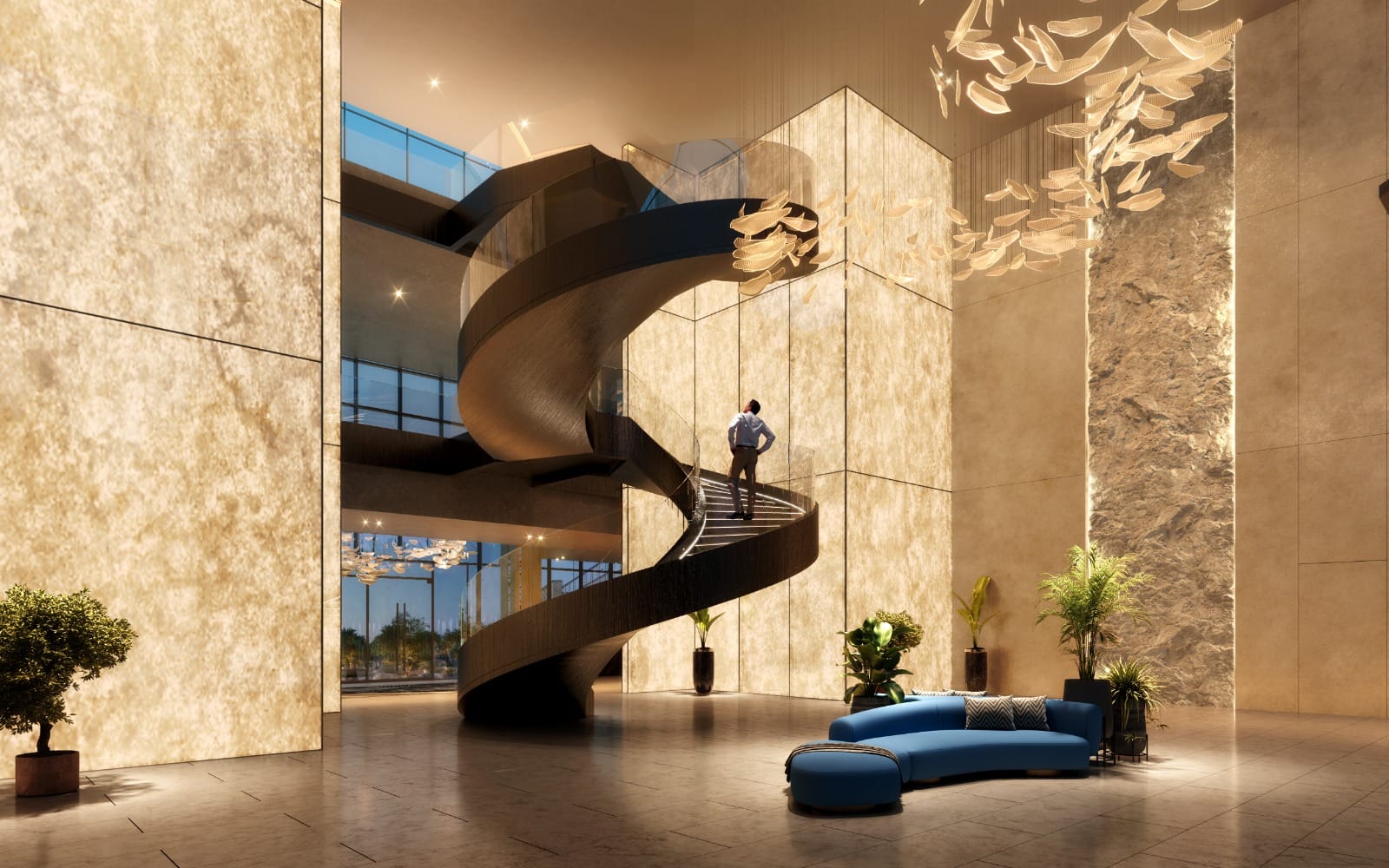
Spiral Staircases
Spiral staircases stand as one of the most technically challenging yet visually stunning architectural features. They do not only serve a functional purpose, but they also create architectural landmarks. Every staircase reflects accuracy in design, precision in fabrication, and craftsmanship during installation.
1. Structural & Architectural Design
Architects first define the staircase’s diameter, total rise, and number of steps, ensuring that the proportions match the space. Engineers then calculate the steel sections that carry both dead loads and live loads. As a result, the staircase balances elegance with strength. In addition, safety standards guide tread width, riser height, and rotation angles to secure comfort and compliance with building codes.
2. Fabrication of the Main Structure
Engineers fabricate the central column from heavy-duty steel pipes that act as the core support. They weld radial brackets to the column to hold each step in place. Moreover, CNC cutting, rolling, and welding machines guarantee smooth curves and accurate dimensions. In large-scale projects, teams add extra beams to reinforce stability.
3. Step Finishes
Designers select step finishes according to the project’s style:
- Craftsmen install marble or granite to achieve durability and luxury.
- Carpenters fit natural wood when the project demands warmth and classic appeal.
- Metalworkers use steel or aluminum for modern or industrial spaces.
In every case, technicians fix the finishes with adhesives, bolts, or custom brackets.
4. Handrails & Balustrades
The choice of railing shapes the final look. For instance:
- Glass with stainless fittings provides a sleek modern appearance.
- Wooden rails highlight a warm or classical design.
- Stainless steel with PVD coatings creates a luxurious impression and resists corrosion.
- Wrought iron enhances traditional and decorative interiors.
5. Cladding & Soffit Coverings
To complete the design, specialists add decorative cladding to the sides and underside of the staircase. Consequently, the stair gains a more refined look. Options include stainless steel panels, powder-coated aluminum sheets, or decorative iron sheets.
6. On-Site Installation
The installation process follows strict steps. First, engineers inspect the site and secure the central column to the concrete foundation. Then, technicians attach the steps one by one around the column. After that, welders and installers strengthen the structure with heavy-duty welds and bolts. Finally, the team inspects the staircase to confirm alignment, railing stability, and finishing quality.
7. Technical Considerations
Spiral staircases must satisfy engineering codes:
- They handle live loads between 3–5 kN/m².
- The central column usually measures 200–300 mm in diameter.
- Step-support plates typically range between 6–10 mm in thickness.
- Tread width stays between 250–300 mm, while riser height remains 150–180 mm.
- Handrail height reaches 900 mm in residential projects and 1100 mm in commercial spaces.
Rounuq Almasar: Where Engineering Meets Art
At Rounuq Almasar, our team designs and fabricates spiral staircases that combine engineering accuracy with luxurious finishes. We customize every project to ensure:
- Strength and safety through structural precision.
- Elegance and beauty through premium finishes.
- Exclusivity tailored to the architectural vision